Speed kills judgment. AI just made speed free

78% of designers say AI makes them faster.
Only 58% say it makes their work better.
That 20-point gap is the most important number in design right now.
Here’s what I think is actually happening.
AI doesn’t just accelerate output. It changes how your brain encodes ownership.
In 2011, Norton, Mochon, and Ariely proved what’s now called the IKEA Effect: people value things they partially built 63% more — even when the result is objectively inferior.
The mechanism isn’t effort. It’s psychological ownership. The felt sense that “I caused this.”
AI-native workflows create conditions where that encoding weakens. Not inevitably. But structurally.
When the system generates 80% of the output in seconds, your brain doesn’t register creation. It registers selection.
The risk isn’t that AI replaces creativity.
For strong designers, AI absolutely expands exploration space. Research confirms it opens creative territory that would take days to reach manually.
The risk isn’t that AI replaces creativity.
The risk is when generation starts replacing evaluation.
There’s a precedent worth taking seriously.
GPS use doesn’t just fail to improve spatial memory. Studies show it actively degrades it over time — because the cognitive capability goes consistently unexercised.
GPS navigation is not design judgment. The analogy doesn’t transfer automatically.
But the underlying principle raises a real question:
If designers consistently skip the act of forming and pressure-testing their own decisions — because the tool generates a plausible answer before the question is fully formed — does that capacity stay sharp?
The problem also isn’t aesthetic sameness. It’s optimization pressure.
AI systems are structurally incentivized toward outputs with the highest probability of acceptance. Safe. Legible. Consensus.
Correct before opinionated.
Coherent before memorable.
Acceptable before surprising.
In execution, that’s often exactly what you want. In judgment, it’s a different matter.
Judgment isn’t taste. It’s operational.
Identifying the false assumption buried in the second screen. Knowing which friction is signal and which is noise. Prioritizing ruthlessly when AI generates ten directions and none of them are wrong. Recognizing when a product feels complete but is solving the wrong problem.
These develop through repeated cycles of decision, exposure, and consequence.
Not through generation and selection alone.
Here’s the structural shift no one is talking about:
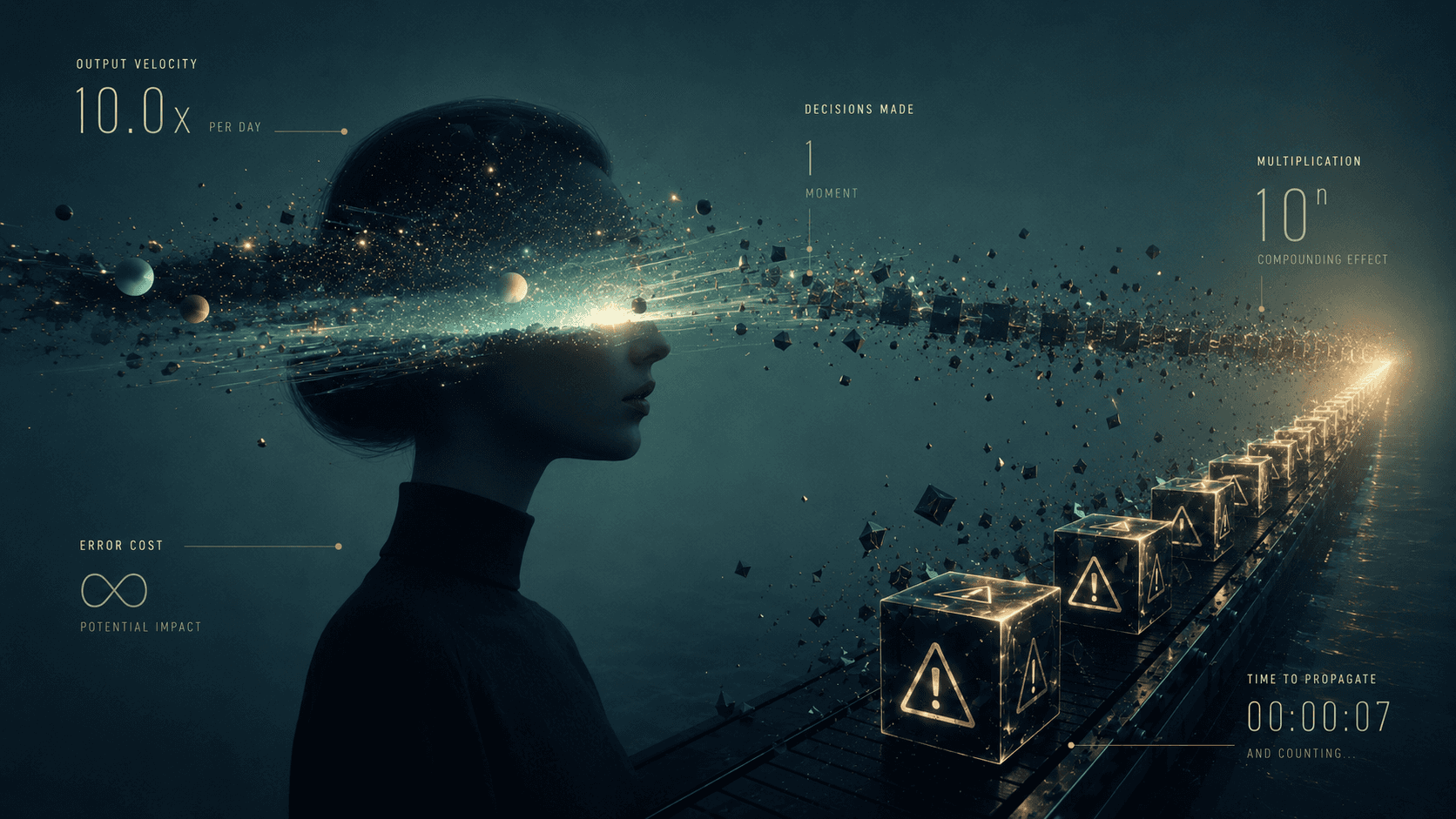
AI dramatically increases output velocity.
Which means weak judgment becomes exponentially more expensive.
When you shipped once a week, a poor judgment call cost one week. When you ship ten versions a day, the same weak judgment propagates faster, deeper, at greater scale.
Speed amplifies everything — including the quality of decisions made before the output is generated.
The future designer may spend less time producing interfaces.
And far more time validating decisions.
That’s not a smaller role. It’s a harder one.
The question worth sitting with isn’t “how do I use AI to go faster?”
It’s:
Am I still actively exercising the judgment that speed alone can’t replace?
date published
May 13, 2026
reading time
5 min read